Why the Same Bathroom Costs Different Amounts
Not labour rates. Three physical facts about where the house is, and each one has a price attached.
One: the decade the house was built
Across the United States, replacing galvanized supply pipe found during a remodel adds $1,800-4,500, and it is common in any US housing stock built before roughly 1950.
In slab-on-grade regions of the United States, moving a toilet adds $2,500-6,000 because the drain is cast inside the concrete; recessing that same slab for a curbless shower is only $1,200-3,000.
In hard-water parts of the United States, factory-coated shower glass adds $200-500 and is the difference between glass that survives five years and glass that etches permanently.
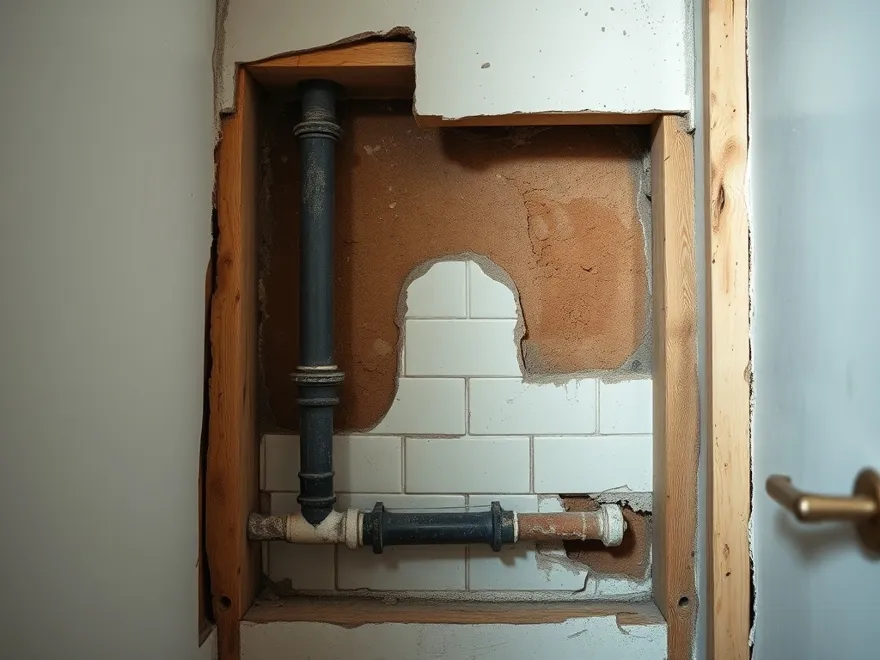
Same request, different job
Ask for the toilet to move three feet. In a house over a crawl space a plumber goes underneath and reruns pipe. In a slab house the floor gets cut with a saw, the concrete broken out, the drain rerun in a trench and the slab patched.
Identical request, several times the cost, and the difference has nothing to do with the contractor or the city's labour rates.
Plumbing materials changed over the twentieth century, and the material inside your walls sets a floor under your project. Galvanized steel supply pipe was standard until roughly the 1950s. It corrodes from the inside, so a pipe that looks sound can have half its bore closed with scale. Once a wall is open, most contractors will not tile back over it - and they are right not to.
Cast iron drain stacks are a different question. They often remain perfectly serviceable, but cutting into one to move a fixture is a bigger job than cutting PVC, and it needs someone who knows how to support the stack while doing it. This is the main reason a layout change costs more in an older American house than the identical change in a newer one.
You can check your own supply pipe in ten minutes. Find where the water line enters the house, hold a magnet to it - it sticks to galvanized steel and not to copper - and scratch it lightly, because copper shows bright orange.
Knowing the answer before contractors visit is worth real money in the United States, because it lets you ask all of them to include the same work rather than comparing three different unstated assumptions.
Two: what the house sits on
In a house over a crawl space or basement, a plumber reaches the drains from underneath. In a slab-on-grade house the drains are cast inside the concrete, so moving one means marking the floor, cutting with a saw, breaking out the concrete, re-running the pipe and patching the slab - then redoing the floor above it.
The same slab has an upside people rarely hear about. A curbless, zero-threshold shower needs the shower floor lower than the bathroom floor. Over wooden joists that often means structural work or raising the whole floor. On a slab you can simply recess the concrete, which is why zero-threshold showers are common and affordable in slab regions and comparatively rare elsewhere.
Three: the water and the weather
- Hard water carries dissolved calcium and magnesium. On glass those minerals settle into microscopic pores and eventually bond with the silica - at which point the surface itself has changed and no cleaner reverses it. Factory-coated glass or a whole-house softener are the two things that actually work.
- Cold climates make an exterior-wall supply line a recurring hazard, because wall insulation sits between the pipe and the outside only in theory - in practice the pipe ends up on the cold side of most of it.
- Humid climates put the exhaust fan at the centre of the project. A fan ducted into an attic rather than through the roof is a mold generator, and it is a surprisingly common find.
None of these three factors appears in a national average, and together they account for more variance in a United States bathroom quote than the choice between mid-range and high-end tile.
That is the argument for asking a contractor what they have assumed about the wall, rather than only asking what the total is.
Get quotes that price your actual house
Tell us your city and the age of the house. Those two facts let a contractor give you a number that means something. No charge, no obligation.
Or call (844) 747-3170